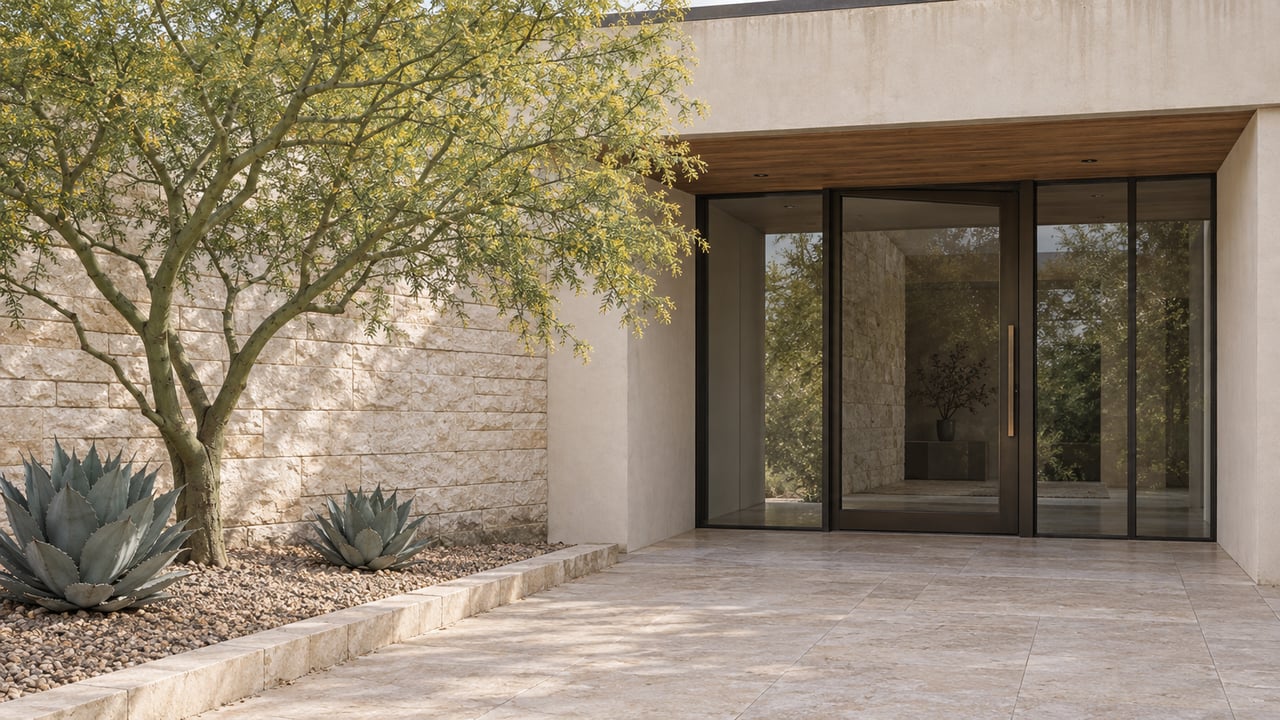
The Line on the Water Map That Sets a Paradise Valley Bill
October 22, 2026
October 22, 2026
Two Paradise Valley homes can sit on similar lots with similar pools and landscaping, yet the water bills that come with them are worked out in completely different ways, because the Town of Paradise Valley doesn't run a water utility. A home's provider depends on which side of a service boundary it sits on. The provider decides whether the monthly bill is mostly a fixed charge or mostly a charge per gallon. That difference decides which home costs less to keep green.
Most buyers never check this until the first bill arrives. In a town where outdoor watering drives most usage, the provider belongs with the septic system and the slope of the lot as one of the details that shapes what a property costs to own.
The Town's own FAQ says that "there are three water providers within the Town of Paradise Valley, including Berneil Water Company, City of Phoenix Water Services and EPCOR Water Company," and that "where you live within the Town determines your water provider." The Town also publishes a water district map showing each provider's area. You can check any address against it before writing an offer.
Berneil is the smallest of the three. Its 2025 annual report to the Arizona Corporation Commission lists 516 single-family accounts, 3 commercial accounts and 9 turf or irrigation accounts as of December 2025. For a Berneil-served home, the company itself is the place to get current rates. The rest of this post compares the two larger providers, EPCOR and Phoenix, because their pricing systems point in opposite directions.
EPCOR's Paradise Valley Water District puts most of the cost into a fixed charge. According to EPCOR's Paradise Valley rate page, a home with a 5/8-inch or 3/4-inch meter pays a basic service charge of $34.18 a month "no matter how much water you use." Water itself is billed in five rising tiers.
| Monthly usage, EPCOR Paradise Valley | Price per 1,000 gallons |
|---|---|
| 0 to 3,000 gallons | $1.40 |
| 3,001 to 7,000 gallons | $2.04 |
| 7,001 to 16,000 gallons | $2.31 |
| 16,001 to 25,000 gallons | $2.52 |
| 25,001 gallons and up | $2.66 |
The City of Phoenix works the other way. Its current rate schedule, in effect since March 1, 2025, charges $4.64 a month for a 5/8-inch meter inside the city. That charge includes 5 units of water, or 3,740 gallons, from October through May and 8 units, or 5,984 gallons, from June through September. After that, every 748-gallon unit costs $4.93, $5.65 or $6.13 depending on the season. An environmental charge of $0.62 applies to every unit metered.
Phoenix charges most customers outside its city limits 150% of these rates. A footnote on the schedule exempts one group: "Users outside the City of Phoenix, except for service within the Town of Paradise Valley, are charged 150% of the applicable rate." So by the schedule's own wording, a Paradise Valley home on Phoenix water is excluded from that surcharge.
Convert Phoenix's per-unit prices to gallons and the gap is clear. In the October and November pricing season, each additional 1,000 gallons from Phoenix costs about $8.38 once you add the environmental charge. EPCOR's highest Paradise Valley tier is $2.66.
At current rates, that difference creates a crossover point. The figures below are rough monthly water charges for a 5/8-inch meter at October rates, before sales taxes and other surcharges. The Phoenix figures use fractional units, and actual bills may round them.
| Monthly usage | EPCOR Paradise Valley | City of Phoenix |
|---|---|---|
| 3,740 gallons | about $39.89 | about $7.74 |
| 7,000 gallons | about $46.54 | about $35.07 |
| 16,076 gallons | $67.52 | about $111.13 |
The $67.52 figure matches EPCOR's own published example for a 5/8-inch Paradise Valley customer at 16,076 gallons. In the fall season, the two systems produce roughly the same bill at about 9,000 gallons a month. Below that, Phoenix's small fixed charge wins. Above it, EPCOR's low per-gallon prices win, and the gap grows with every thousand gallons.
For a buyer, this changes how two addresses compare. A lightly watered home, or a second home that sits empty for part of the year, costs very little to keep on Phoenix water and pays EPCOR's $34.18 basic charge whether or not anyone turns on a tap. A home with turf, a large pool and mature landscaping is cheaper to run on EPCOR at today's rates. EPCOR's rate page says it plainly: "Higher usage, often from outdoor watering, moves into higher ranges."
EPCOR's own documents show how differently it views this district. On its Paradise Valley rate page, the example "typical" customer uses 6,500 gallons a month and pays $45.52. But in the bill comparisons for its 2026 rate case, every other district is shown at 7,000 gallons, and Paradise Valley is shown at 16,076 gallons on a 5/8-inch meter. A second Paradise Valley example uses 51,770 gallons on a 1-inch meter, with a current bill of $189.15.
The structure of the case follows the same pattern. EPCOR filed the application with the Arizona Corporation Commission on June 29, 2026. It covers the Gateway, Paradise Valley, Rio Verde, Sonoran, Sun City and Sun City West districts and asks for about $41.1 million in additional revenue, roughly 30.1% over adjusted 2025 test-year revenues. EPCOR proposes merging every one of those districts except Paradise Valley into the Sonoran Water District over three yearly steps. Paradise Valley would stay standalone until a future rate case, and its rate design would go from five tiers to four.
Under EPCOR's proposal, the 16,076-gallon example would rise from $67.52 to $85.32 a month, and the 51,770-gallon example would rise from $189.15 to $229.98. Even at the proposed $85.32, the 16,076-gallon EPCOR bill would still be below the Phoenix figure at today's October rates. EPCOR's public notices don't yet show the new tier breakpoints, so a heavily irrigated property's future bill depends on where those lines end up.
EPCOR is also asking for an Annual Rate Adjustment Mechanism for the Paradise Valley and Sonoran districts. This would let it request up to five yearly rate adjustments before its next full rate case, up or down, depending on whether its earnings fall outside a set range. Each adjustment would still need Commission approval. If approved, the bill for an EPCOR-served Paradise Valley home would be reviewed every year rather than reset only once every several years.
None of the proposed rates are in effect. The notice states that the Commission "is not bound by the proposals" and that final rates "may be higher, lower, or different." Here is where the case stands as of mid-October 2026:
Prices on the Phoenix side may be moving too. In August, the Arizona Republic reported that Phoenix is considering raising water rates as the state braces for Colorado River cuts. After the federal Record of Decision, a City of Phoenix release said reduced Colorado River deliveries begin in 2027. Mayor Kate Gallego said the City would "push for new federal support to mitigate the rising cost of water that will result from this federal decision." The release puts the Colorado River at about 40% of Phoenix's drinking-water supply. No new Phoenix rate schedule has been published, so the March 2025 schedule remains the current one.
A buyer who closes this fall will probably own the home through both decisions. The provider and meter on the property will decide which one shows up on the bill.
Finding out the provider and meter size takes a few minutes during the inspection period.
Does Paradise Valley set water rates? No. EPCOR's rates are reviewed and approved by the Arizona Corporation Commission, and Phoenix publishes its own rate schedule for the water it supplies.
Will EPCOR's proposed Paradise Valley rates definitely take effect? No. The hearing doesn't begin until April 19, 2027, and the Commission can approve rates higher than, lower than or different from EPCOR's proposal.
Who can answer questions about how the proposal affects a specific bill? EPCOR takes rate case questions at 1-800-383-0834 or [email protected].
The bill estimates in this post are general information based on published rate schedules and pending proposals. Confirm the charges for any specific property with its water provider.
Cassandra Cook brings more than 25 years in real estate and finance to that kind of math, whether you're weighing two Paradise Valley addresses or preparing to sell one. Request a free home valuation to see how your property's full carrying costs fit its price.
Stay up to date on the latest real estate trends.


Cassandra Cook
Address
8388 E Hartford Dr Ste 100
Scottsdale AZ 85255