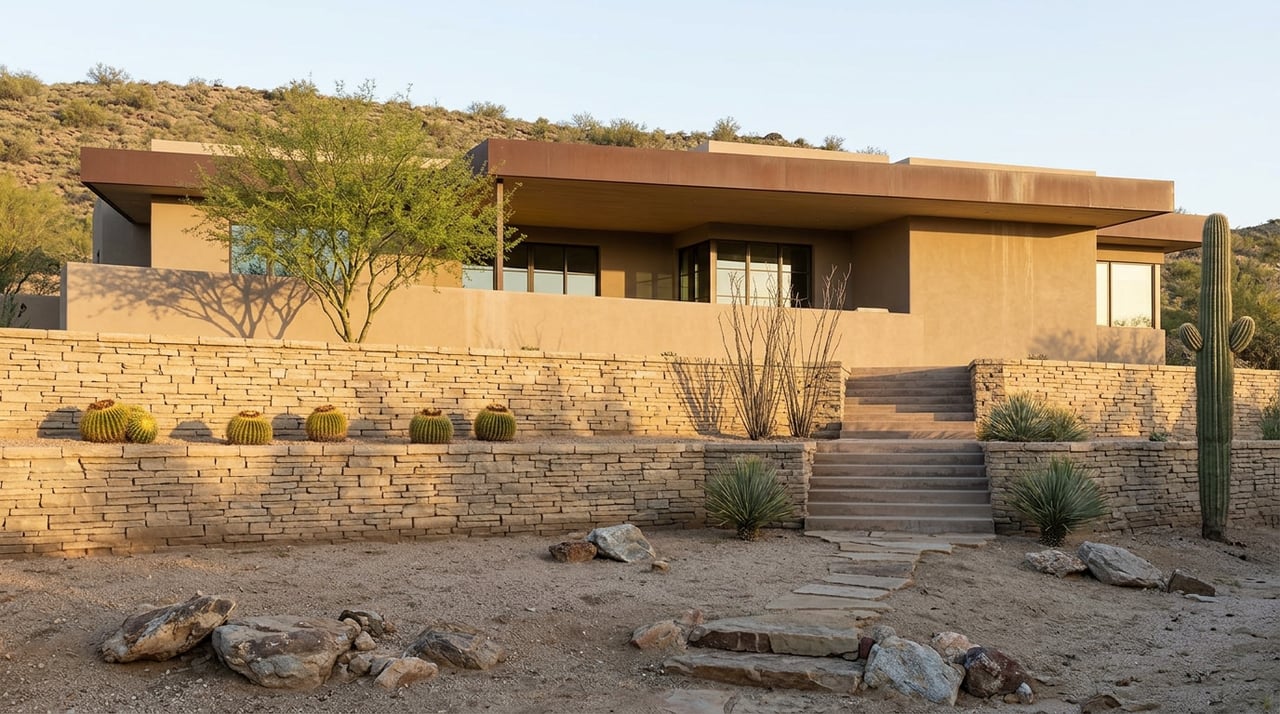
Paradise Valley Hillside Building Restrictions: How Slope Limits Your Build
September 17, 2026
September 17, 2026
Two lots go up for sale on the same street in Paradise Valley, both listed at one acre and priced within a few hundred thousand dollars of each other. On paper they read as interchangeable. In practice, one can support a sprawling single-story estate with a pool, a casita, and a motor court. The other, because of a grade change most buyers never think to ask about, may face tighter limits on what can be built. The acreage on the listing sheet never changes. What changes is the slope beneath it, and in this town, slope is the number that actually runs the deal.
That gap between what a lot looks like and what it can hold is written directly into the Town of Paradise Valley's Zoning Ordinance, and it catches out-of-state buyers, move-up sellers, and even some local ones off guard often enough that it deserves its own explanation before anyone writes an offer.
Paradise Valley's Article XXII, the Hillside Development Regulations, applies to any building site with a natural slope of 10 percent or more, whether the town has mapped it as hillside terrain or not. The article does not cap what you build by lot size. It caps how much of the natural ground you are allowed to disturb at all, on a sliding scale that gets stricter as the grade steepens.
| Building-site slope | Disturbed area allowed |
|---|---|
| 10% | up to 60% |
| 15% | about 34% |
| 20% | about 20% |
| 25% | about 13% |
| 40% | about 10% |
| Past 50% | single digits |
Disturbed area means anything altered by grading, cutting, filling, clearing native vegetation, or trenching. It is the practical footprint available for the house, the driveway, the pool, and the yard around it. A one-acre lot at a 10 percent slope leaves you room to work with. The same acre at 25 percent slope leaves you working inside roughly an eighth of it, and that includes the driveway.
Height follows the same logic. On hillside-designated lots, the primary structure is measured against a 24-foot plane that runs parallel to the pre-development natural grade, not a flat ceiling from the lowest point of the lot. Accessory structures top out at 16 feet, and the overall building cannot exceed 40 feet from its highest point to the lowest natural grade anywhere on the site. Cuts to establish a pad or driveway are capped at 30 feet deep, and after final grading no more than 5 percent of the lot may end up steeper than it started. None of this appears on a listing photo. All of it appears on the survey.
The town's own Mummy Mountain development page is a useful illustration, because it shows Article XXII operating on a real, active project rather than as an abstract rule. Development on the mountain is governed by a Partial Judgment and Settlement Agreement from 2002 that restricts three specific buildable parcels, labeled I-A, I-C, and II, to defined building envelopes. As construction has proceeded on the site, the town has continued referencing that 2002 agreement alongside Article XXII to confirm each new phase stays inside its assigned envelope. One approved driveway cut on the site is limited to 30 feet deep and 12 feet wide through the primary ridgeline, and it has to be screened by landscaping from view on both sides. That is not a hypothetical restriction. It is the actual condition attached to an actual parcel, and it shows how literally the town treats the word "envelope."
A few miles away in the Clearwater Hills subdivision, a Maricopa County Board of Adjustment case from 2020 shows what happens when that envelope gets misread. The property in question carried natural slopes at or above 15 percent with elevation changes of 10 feet or more, which placed it squarely under hillside development standards. A dispute arose over grading conducted outside the lot's approved building envelope, and the owner ultimately filed a variance request tied to the extreme slope and the depth of rock cut the home required. The case dragged into a continuance so the property owner could work out drainage concerns with a neighboring owner. None of that shows up on a listing sheet. It shows up in county records, and it shows up in construction timelines.
Slope is not the only thing that can shrink a buildable pad. A wash setback, tied to the town's drainage designations and FEMA floodplain mapping, can independently constrain a lot regardless of how gentle the grade looks standing in the yard. A lot can pass every slope threshold with room to spare and still lose a meaningful chunk of its buildable area to a wash that only shows up on a drainage map. This is the kind of detail a walk-through will not surface. A drainage map will.
Custom construction in Paradise Valley now runs somewhere between 500 and 1,000-plus dollars per square foot, the top of the range anywhere in metro Phoenix as of 2026. The instinct is to read that number as a finish-level decision, marble versus tile, imported stone versus domestic. It is not, or at least not primarily. Hillside review helps set how much home the ground can physically hold before a single finish is chosen. A second story compounds the math further. According to Jematell Homes, on an R-43 lot, going up a floor doubles the required side yard from 20 feet to 40 feet, which eats into the very footprint the slope table already constrained. Buyers comparing Paradise Valley to Scottsdale or Phoenix on a price-per-square-foot basis are often comparing a site-constrained build to an unconstrained one without realizing it.
One more source of confusion is worth clearing up directly, because it shapes how buyers research the area online. The Town of Paradise Valley is its own incorporated municipality, with its own zoning authority, its own Article XXII, and its own Hillside Building Committee. Paradise Valley Village, a separate area inside the City of Phoenix near Cactus Road and Tatum Boulevard, is governed by Phoenix's own hillside provisions, not the Town's. A buyer searching listings can land in either area under the same name and assume the same rules apply. They do not. Confirming which jurisdiction actually governs a specific parcel is the first step, not an afterthought, and it is worth doing before any slope table gets pulled at all.
Does the slope table apply even if the lot looks mostly flat? Yes. Article XXII applies wherever the natural terrain under the building pad slopes 10 percent or more, mapped or not. A single steep pocket, sometimes created by a wash, can pull an otherwise gentle lot into hillside review.
Is a second story always possible on a hillside lot? It depends on the height plane, the required setbacks, and whether the design steps with the terrain rather than sitting on a single flat pad. Stepping the structure is often the only way to add volume without breaching the height plane.
Does an HOA approval replace the town's review? No. Architectural committee approval within a private community and the Town's Hillside Building Committee review are separate processes, and both are required.
A lot's acreage tells you what you are paying for. It does not tell you what you can build. In a town where the ground itself is regulated down to the percentage point, that distinction is worth confirming before it becomes a change order.
If you are comparing lots in Paradise Valley and want a clear read on what a specific parcel's slope and zoning actually allow before you make an offer, Fine Properties Arizona can walk you through it. Get a Free Home Valuation to start the conversation.
This article is general information, not legal, tax or financial advice. Consult a qualified professional about your situation.
Stay up to date on the latest real estate trends.
Cassandra Cook
Address
8388 E Hartford Dr Ste 100
Scottsdale AZ 85255