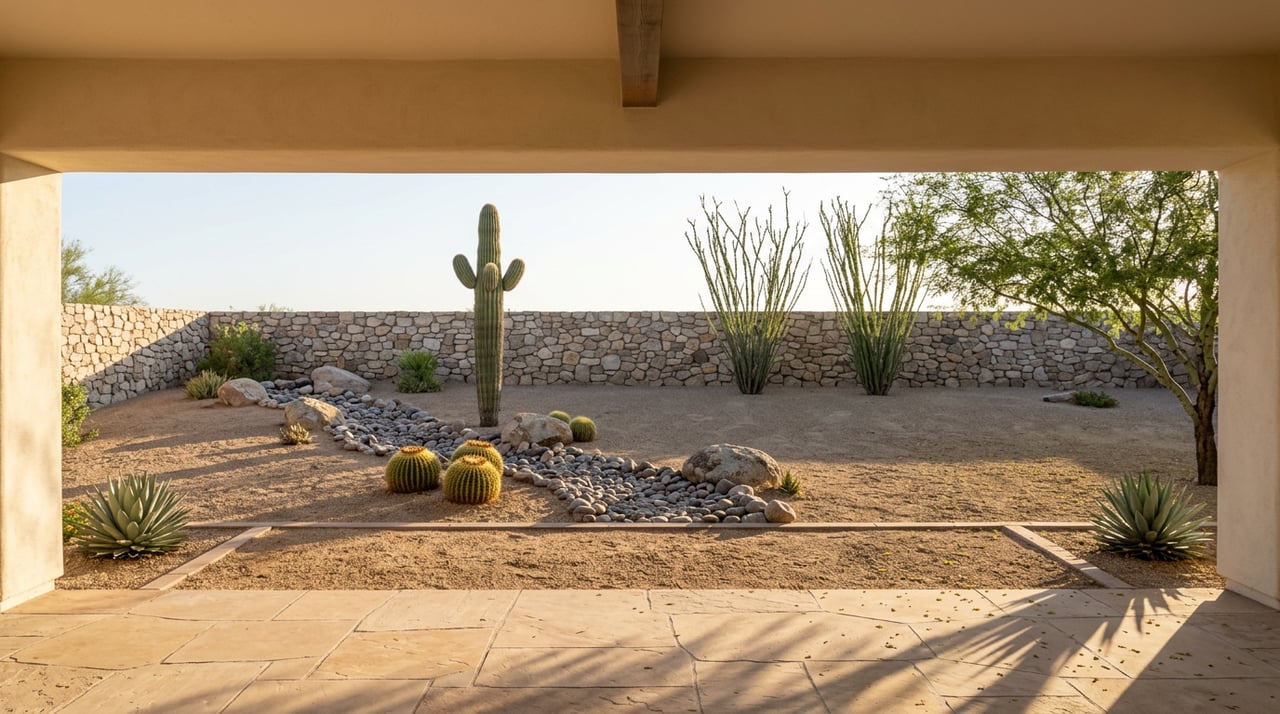
The Real Reason You Keep Seeing the Same Coyotes in Paradise Valley
September 3, 2026
September 3, 2026
"A Fed Coyote is a Dead Coyote." That line sits on the Town of Paradise Valley's own coyote safety page, not on a wildlife blog or a pest control ad. It is the town's shorthand for a problem it has spent years trying to explain to residents: the coyotes showing up on the same street at the same hour of the same week are not passing through. They are staying, because someone nearby is feeding them, and the town has had to make that a crime.
Most write-ups about desert wildlife in Paradise Valley treat coyotes and javelina as background scenery, part of the price of admission for mountain views and big lots. That framing misses what the town's own guidance actually says. This is not a story about wilderness at the edge of the neighborhood. It is a story about a wildlife population that has learned the neighborhood, and about the small, specific choices that keep it coming back.
Under Section 7-2-6 of the Paradise Valley Town Code, feeding wild coyotes is a misdemeanor, and a conviction carries a $250 fine. The town does not publish that rule as a formality. Its own coyote page states plainly that regular coyote presence in a yard is the result of a nearby food source, and that if a coyote keeps returning to your block, someone in the neighborhood is feeding it, whether they mean to or not. A pet bowl left outside, unsecured trash, dropped citrus, fallen dates from a landscaped palm. None of it looks like feeding a wild animal. All of it functions that way.
The town also traces where coyotes actually den, and it is not the far edge of the preserve. Dens turn up in storm drains, under sheds, and in thick, dense vegetation that blocks a clear view of the entrance, the same features that show up in ordinary backyards, washes, and golf-course rough. Coyotes occur wherever substantial open space remains, whether that is a mountain preserve, a golf course, or simply a larger block of undeveloped land, and Paradise Valley has more of that per household than almost anywhere else in the Valley. The animals are not commuting in from somewhere wilder. They are denning inside the boundary of the town, in the same drainage infrastructure that keeps a monsoon storm from flooding a driveway.
That is the piece most casual coverage skips. The coyote you see at dusk twice a week is not a random encounter with nature. It is a resident with an address, sustained by a food source that a neighbor is providing, and protected from casual removal by a fine the town felt it necessary to write into code.
The Paradise Valley coyote page is unusually specific about behavior, and it is worth reading in full rather than summarized secondhand. A few of its recommendations that apply directly to an evening walk:
That last point matters more in Paradise Valley than in a denser suburb, simply because of how much unfenced, connected open space runs through residential lots here. A coyote litter averages four to five pups, and family groups stay together through summer into early fall, which is exactly the season when a homeowner is most likely to be outside at dusk with a small dog on a long leash.
Part of what makes this confusing at first is that a coyote at 50 yards in fading light can look like a neighbor's dog off leash. The physical differences the town lists are specific enough to actually use. Adult coyotes weigh 20 to 30 pounds and stand 18 to 21 inches tall, with a body length of 42 to 50 inches nose to tail. Their coat runs gray with a rusty tint across the neck and flanks, their ears sit more erect than a dog's, and their tail carries low, with distinct black patches at the base and tip that most house pets do not share. It is a small detail, but it is the difference between calling out to a neighbor and knowing to start making noise and moving toward light.
Coyotes are sustained by feeding habits. Javelina follow a different logic, and it produces a genuinely counterintuitive result. A recent feature on Scottsdale-area desert wildlife found that javelina sightings do not track most closely with proximity to preserved desert land. Downtown Scottsdale and central neighborhoods like McCormick Ranch sit close to protected open space and still see comparatively few javelina, largely because of denser development. Sightings become steadily more common moving north and east, specifically toward Cave Creek, Paradise Valley, and Carefree, where development thins out and larger lots back directly onto intact habitat.
In other words, it is not the presence of a nearby preserve that predicts javelina in the yard. It is lot size and density. Paradise Valley's larger parcels and lower housing density, the same qualities that show up in its market data as low, put it in the same javelina-frequency tier as Cave Creek and Carefree rather than with more built-up Scottsdale neighborhoods that are technically just as close to the mountains. Javelina move in family groups, are most active at dawn and dusk, and despite the nickname, are not pigs at all but collared peccaries, native to the region only in relatively recent geological terms. They are also, by most accounts, far less aggressive than their reputation suggests. The animal a resident is most likely to actually need to manage carefully is still the coyote, not the javelina.
This is not a niche interest invented for a blog post. The Desert Foothills Land Trust, which stewards close to 1,100 acres of preserved Sonoran Desert across the north Valley, runs a recurring Foothills Speaker Series with the Holland Center in partnership. On January 6, 2026, that series brought in Jeff Meyers of the Arizona Game and Fish Department for a session dedicated entirely to javelina, open to the public and free to attend. It is the kind of programming that exists because residents in this part of the Valley are actively trying to understand the animals sharing their washes and golf-course edges, not because a wildlife encounter is rare enough to be a curiosity.
For anyone who wants the primary source rather than a paraphrase, the town's coyote guidance is posted in full on the Town of Paradise Valley's website, including the code section, the fine, and the complete list of recommended precautions. It is a short read, and it is a more useful ten minutes than most general desert-wildlife advice, because it is written for this specific place.
None of this changes what makes a Paradise Valley property valuable, the mountain views, the privacy, the mature landscaping on a lot large enough to actually notice a wash running through it. It does mean that the wildlife on that lot is not incidental scenery. It is a population sustained in part by daily choices, and managed by a town that has had to legislate around the fact that people keep feeding it. Understanding that distinction, rather than treating every sighting as an isolated event, is what actually changes how a resident walks a dog at 7 p.m. in July.
If you are weighing what daily life in Paradise Valley actually feels like, beyond the listing photos and the market numbers, Cassandra Cook of Fine Properties Arizona can talk through the details that matter once you are living here, not just buying in. Reach out for a conversation about the neighborhood, or request a free home valuation to see where your property stands today.
Stay up to date on the latest real estate trends.

Cassandra Cook
Address
8388 E Hartford Dr Ste 100
Scottsdale AZ 85255