The Ordinance That Keeps Paradise Valley's Streets Dark After Sunset
August 20, 2026
August 20, 2026
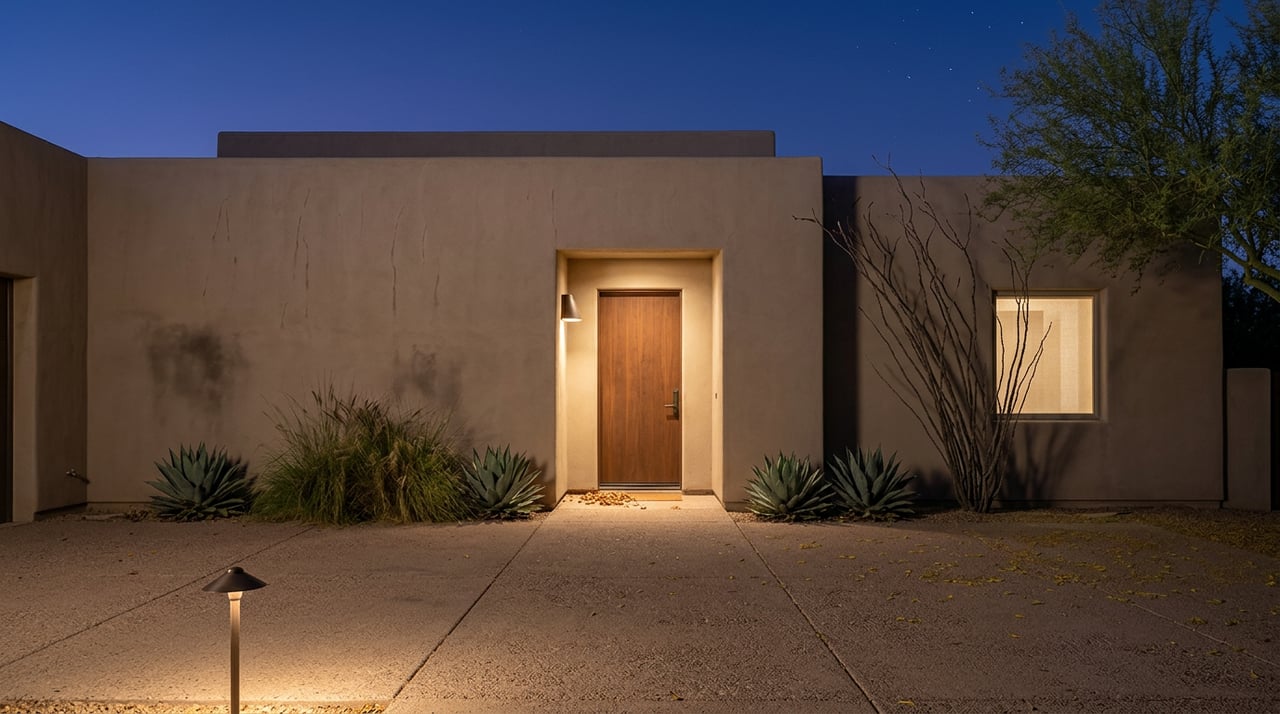
Walk out your door on Tatum Boulevard or a side street off McDonald Drive an hour after sunset and the first thing you notice is what is missing. No pool of sodium light at the corner. No glow bouncing off the pavement ahead. Just your own porch light, the shape of a saguaro against a slightly lighter patch of sky, and whatever your phone flashlight can manage. Most people who move here from almost anywhere else reach for that flashlight out of habit before they realize they do not actually need it once their eyes adjust.
It is easy to assume this is just an old desert town that never got around to installing streetlights. That is not what is happening. Paradise Valley has an active outdoor lighting ordinance on the books right now, with specific numbers attached to it, and the darkness on your street is the ordinance working as intended.
The town's outdoor lighting code, found in Section 152.059 of the municipal code, is more precise than most residents realize. Residential exterior lighting is capped at 1,600 lumens per fixture. Anything brighter than that has to be fully shielded so it cannot spill onto a neighbor's property. Security and landscape lighting must point downward and stay under a color temperature of 3,000 Kelvin, which is the warm, amber-leaning end of the spectrum rather than the bluish-white light you see under a gas station canopy.
A few specifics worth knowing if you are the one choosing fixtures:
Fixtures installed before April 22, 2023 that do not meet these standards are treated as legal non-conforming, but only until they go dark for six months or need repairs serious enough to require replacement. At that point, whatever goes back up has to meet the current code. The rule is not a relic. It is actively reshaping what gets installed on new builds and what happens when an old floodlight finally burns out.
None of this happened by neglect. Paradise Valley incorporated in 1961 specifically to avoid being annexed by Phoenix or Scottsdale, and the founders were explicit that they were trying to protect a sparsely populated desert lifestyle from the density and commercialization they saw creeping in next door. By 1970 the town had grown to roughly 13 square miles and had already put an Underground Utilities Ordinance in place, along with the low-density residential rules that still govern most lots today. The historical record around that era notes that the town's character was shaped in part by ordinances limiting outdoor lighting and excessive noise, well before the town's first formal General Plan was adopted in 1980.
In other words, the dark street outside your house is not an infrastructure gap waiting to be filled. It is the same instinct that gave Paradise Valley its one-acre minimum lot sizes and its Hillside Building Committee, applied to what happens after the sun goes down.
A dark street is not an empty one. Coyotes are among the most commonly seen wild animals in the Phoenix area, and the town's own guidance on the subject is specific about where they turn up: wherever substantial open space remains, including mountain preserves, golf courses, and larger blocks of undeveloped land. That description covers a lot of Paradise Valley, where golf-adjacent lots and generous setbacks are the norm rather than the exception.
Wildlife officials with Arizona Game and Fish have pointed out that golf courses and greenbelts tend to have higher concentrations of coyotes simply because there is more prey there, more rodents and rabbits drawn to the water and vegetation. Sightings also tend to climb whenever the weather is pleasant enough that both people and animals are out more.
The town's own coyote guidance offers a short list of habits worth adopting if you are walking a dog in the evening:
None of this is meant to make an evening walk sound risky. It is meant to explain why your neighbors who have lived here a while already carry a whistle clipped to the leash, and why the loop around the golf course tends to be busier at dusk than at midday.
The same absence of streetlights that changes how you walk the dog is also why Paradise Valley nights reward looking up. Arizona has close to 20 certified International Dark Sky Places statewide, a reflection of just how seriously dark skies are treated here as a resource rather than a coincidence. You do not need a formal designation to notice the difference between a sky washed out by sodium light and one where the Milky Way is actually visible on a clear, moonless night.
For residents who want to take that further than a casual glance upward, the Phoenix Astronomical Society holds public star parties and workshops at Paradise Valley Community College, a short drive from most PV neighborhoods and open to anyone curious enough to bring a lawn chair.
None of this is a reason to move here or a reason to leave. It is simply what is true about the street you are already on, tonight, after the sun goes down. The darkness is not something the town forgot to fix. It is a number on a page, a shielding requirement, a color temperature ceiling, all of it enforced on the same one-acre lots that give Paradise Valley its particular quiet. Once you know the ordinance is there, the dark street stops feeling like an oversight and starts feeling like the point.
If you are thinking about what your own property is worth in a market that prizes exactly this kind of quiet, Cassandra Cook can walk you through a free home valuation grounded in what is actually happening on the ground in Paradise Valley, not just the comps on a screen.
Stay up to date on the latest real estate trends.
Cassandra Cook
Address
8388 E Hartford Dr Ste 100
Scottsdale AZ 85255