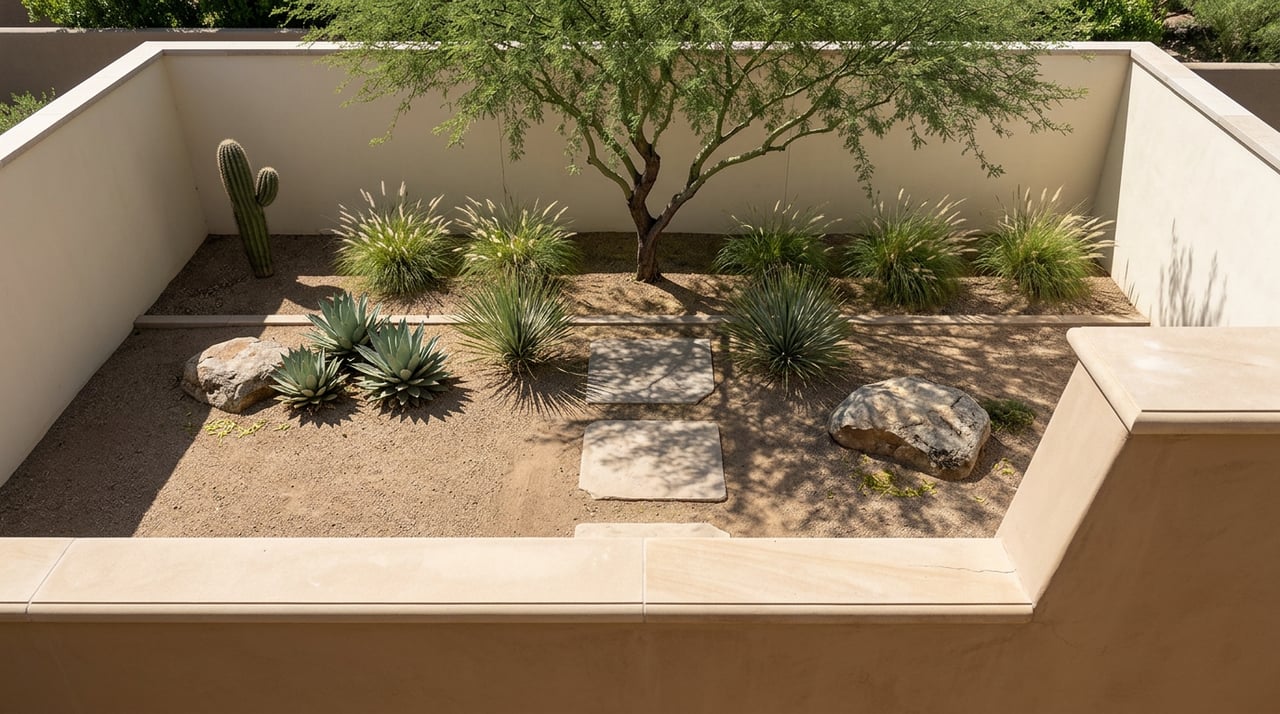
Why Paradise Valley's Priciest Homes Still Run on a Six-Month Septic Clock
August 27, 2026
August 27, 2026
Ask most Valley buyers what could stall a closing on a multimillion-dollar estate, and they will guess a stubborn appraisal, a slow lender, or a disputed repair. Few guess a septic tank. In Paradise Valley, that guess deserves to move higher on the list. A meaningful share of the town's estate lots, from flat infill parcels near Old Town Scottsdale to hillside compounds ringing Mummy Mountain, still send their wastewater into the ground rather than into a municipal line. Arizona treats that detail as a legal event with its own clock, one that a purchase contract cannot simply write around.
The rule governing that clock is stricter, and far less forgiving of delay, than almost anything else buyers and sellers negotiate in a Paradise Valley sale.
Paradise Valley incorporated in 1961 largely to keep density out, and the zoning it wrote has barely moved since. The town's base residential district, R-43, requires a full acre for a single home. The largest district, R-175, requires more than four acres. There is no small-lot single-family zoning anywhere in town the way there is in Phoenix or Mesa.
That choice protected mountain views and dark skies, but it also meant the town never had the density to justify extending sewer lines to every parcel. Large stretches of Paradise Valley, particularly the older enclaves along the Cheney Drive corridor and the hillside neighborhoods around Mummy Mountain, were built with:
None of this is a defect in the housing stock. It is the direct byproduct of the same low-density rules that keep Paradise Valley's lots large and its rooflines low. Septic is not a rare exception here. Outside the town's newer, sewer-connected pockets, it is closer to the default.
Arizona has regulated septic transfers since a limited pilot began in January 2002, expanded statewide in July 2006. The rule, Arizona Administrative Code R18-9-A316, requires anyone selling a property served by a conventional or alternative onsite wastewater system to retain a qualified inspector and have the system inspected within six months before the transfer closes. That inspection almost always includes pumping the tank, not simply examining it.
What makes this rule unusual is not the inspection itself. Home inspections are routine and negotiable. This one is neither. As Maricopa County's own guidance describes it, the requirement
"takes precedence over any conflicting terms that may exist in any contract pertaining to the property transfer."
A buyer and seller can agree to waive a home inspection, a termite report, even certain disclosures, where state law allows it. They cannot contract their way out of the septic inspection. The only exemption is a system that has never been used, typically a brand-new build that has not yet had a first flush. Everything else must be inspected, on the clock, regardless of what the purchase agreement says.
| Scenario | Transfer Inspection Required? | What the Buyer Must Still Do |
|---|---|---|
| Resale of a home actively using a septic system | Yes, completed within six months of closing | Receive the signed Report of Inspection and any maintenance records before closing |
| New system built but never placed in service | No | File a Notice of Transfer using the system's permit number and approval date |
For sellers, the practical sequence looks like this:
The tight window is where deals get expensive. If a home does not sell within six months of the inspection date, Arizona requires the whole process to start over. A renegotiated price, a financing delay, an appraisal gap, or simply a buyer who wants more time for due diligence can push a closing past that mark. When that happens, the seller pays for a second inspection and a second pump-out on a system that may not have taken on any additional use in the interim. It is one of the few costs in a Paradise Valley sale that resets itself purely on a calendar, independent of anything the house actually did.
Paradise Valley's hillside lots complicate the picture further. Any parcel with a slope of 10 percent or more falls under the town's Hillside Building Committee, established under Article XXII of the zoning ordinance. The rule caps how much of a lot can be disturbed by grading, cutting, filling, or clearing, and that cap tightens quickly as the ground gets steeper. At a 10 percent slope, up to 60 percent of the site can be disturbed. At 15 percent, that falls to roughly 34 percent. At 25 percent, it drops to about 13 percent, and beyond 50 percent slope the allowance falls into the single digits.
A septic system needs more than a tank. State site rules require enough land for the primary drain field and a full reserve area in case the first one fails. On a flat acre in the Cheney corridor, finding that space is straightforward. On a hillside lot in Mummy Mountain Estates, the Foothills, or Clearwater Hills, the same disturbance limits that protect the mountain's profile also shrink the usable footprint for a septic system and its backup field. Buyers evaluating a hillside estate with a future rebuild or addition in mind should confirm where the existing system and reserve area sit relative to the disturbance envelope before assuming a larger footprint is possible.
The pattern shows up in real listings, not just in theory. One infill lot near Old Town Scottsdale, priced under $2 million and marketed for its unobstructed Camelback Mountain views, disclosed exactly this: the property sits on septic, is being sold as is, and carries PV R-18A zoning with a 25 percent lot coverage cap. A buyer planning to demolish and rebuild on that lot still inherits the transfer rule. Arizona's septic law is triggered by a change in ownership, not by whether the house standing on the land today will survive the year. Unless the county confirms the existing system was truly never used, the outgoing owner still owes an inspection, and the incoming owner still owes a Notice of Transfer and its fee, even when the septic tank itself is scheduled for removal within months.
No. Some newer developments and pockets with municipal infrastructure already in place are connected to sewer. But given the town's one-acre minimum lot sizes and its history of low-density zoning since incorporation in 1961, septic remains common, especially in older enclaves like the Cheney corridor and the hillside neighborhoods around Mummy Mountain.
State rule places the obligation on the seller, who must retain the inspector and deliver the completed report to the buyer before closing. Buyers typically handle the separate Notice of Transfer fee after closing, since that filing is the buyer's responsibility.
Not automatically. A rating of Not Functional does not void a contract on its own. It becomes a negotiating point, similar to any other inspection finding, and buyers and sellers typically address repairs or price adjustments through the purchase agreement. What cannot be negotiated away is the inspection itself.
The transfer rule applies regardless of the system's age or installation date. Arizona's Department of Environmental Quality accepts Notices of Transfer for systems built and operating both before and after January 2001.
For sellers, the smartest move is scheduling the septic inspection early, before a buyer's financing clock starts ticking, so the six-month window comfortably covers the marketing period and closing. For buyers, it means asking for the Report of Inspection early in due diligence, not at the closing table, so a Functional with Concerns rating has time to become a repaired system or a renegotiated price instead of a delay.
Cassandra Cook built her practice at the intersection of real estate and financing, and questions like this one, the kind that live in the fine print of an Arizona statute rather than the listing photos, are where that background earns its keep for clients. If you are weighing a purchase or a sale in Paradise Valley and want a clear-eyed read on what a specific property's infrastructure means for your timeline and your budget, reach out to Fine Properties Arizona for a free home valuation and a conversation grounded in how this market actually closes.
Stay up to date on the latest real estate trends.

Cassandra Cook
Address
8388 E Hartford Dr Ste 100
Scottsdale AZ 85255